
I enjoy observing how different businesses are organized. I often find myself thinking about why things are done in a specific way and whether I would do anything different. Understanding the complexity of businesses outside of your own industry is a valuable skill because there are many transferable lessons.
When I refer to businesses, I mean a wide variety of operations. This includes how a restaurant organizes its kitchen and waiting staff, how a large event manages safety and crowds, or even how airport operations function.
A Unique Visit to the Pulpí Geode
During my last Christmas holidays, I had the opportunity to visit a unique location near Almería: La Geoda de Pulpí. For those who are unfamiliar, a geode is a hollow rock with a cavity lined with crystals. This specific geode is the largest in the world and the only one that can be visited by the public.
The process is highly structured. You must book a slot at a specific time (in intervals of 30 minutes) as part of a group of ten to fifteen people led by a guide. The visit lasts almost two hours and takes you through various halls of an old iron, lead, and silver mine. However, the mine is not the primary objective. Everyone is there to see the geode at the deepest part of the mine. The climax of the visit involves looking through a small hole, one person at a time, to see the crystals.

Identifying the Process Bottleneck
In operations management, this viewing point is clearly the Critical Path and the bottleneck. The profitability of this business depends entirely on how well the managers optimize the time spent looking through that hole. To maximize efficiency, the management has implemented two clever strategies from my point of view:
- Automated Timing: The geode features artificial lighting that the guide activates. An automatic timer turns the light on for thirty to sixty seconds per person. This ensures the process remains under strict control.
- Centralized Photography: Visitors are forbidden from taking their own photos or videos. Instead, the guide takes professional pictures of you at every relevant spot. You can receive these via email later for only 1 EUR.
Initially, I thought these rules were for safety. However, I soon realized it was a matter of throughput. To maximize the use of the resource, each group must have a takt time of exactly thirty minutes. Prohibiting personal photography prevents individuals from taking longer than planned, which would cause delays for the following groups.
Applying “The Goal” to Real Life
I am not certain if the managers have read the book The Goal by Eliyahu M. Goldratt, but they certainly run the operation “by the book”. I first read this book in October 2018. At that time, I was preparing to move to a different role in a different factory with a more industrial manufacturing setup. My manager told me that the new factory was a perfect example of the principles explained by Goldratt.
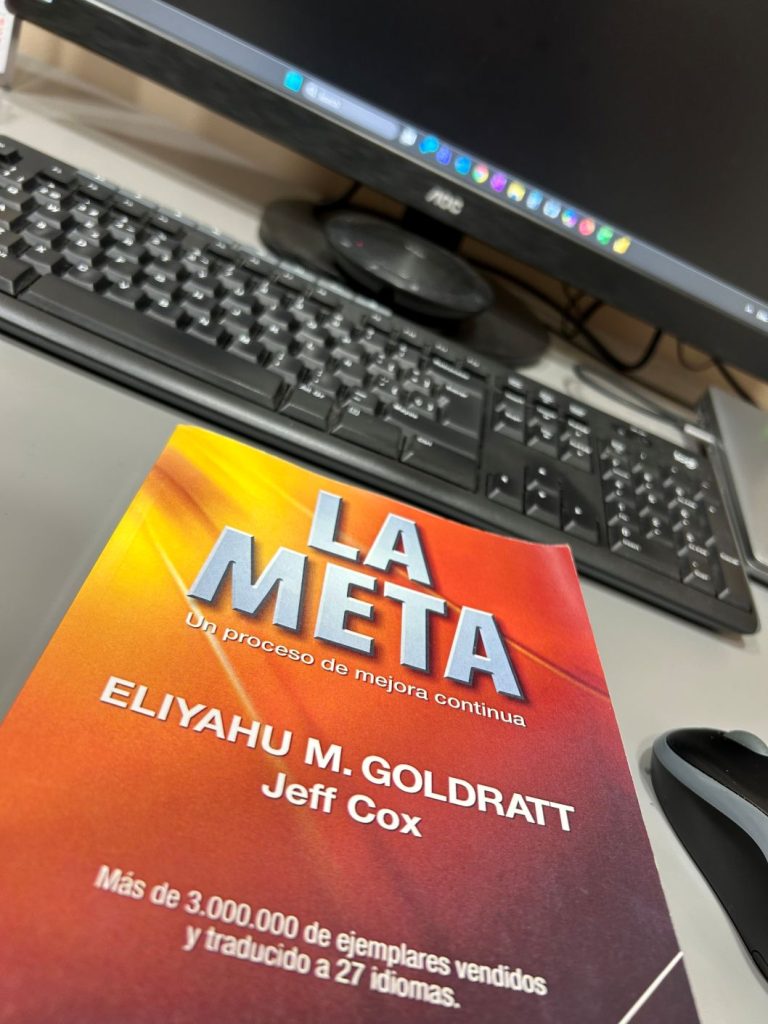
The core lesson is simple: in any system, there is one specific resource that limits the total output. If you do not optimize that resource, you are losing capacity, and typically money. Since reading that book, I always look for the critical resource and think about how to maximize it, no matter where I go.
Whether it is a crystal geode in Spain or a manufacturing plant in Germany, the logic remains the same. You must protect the bottleneck to ensure the entire system functions at its peak.
Have you ever identified a bottleneck in a place you did not expect, such as a restaurant or a tourist attraction? Am I alone in this “hobby”?
Leave a Reply