
Over the holidays, I had the chance to spend quality time with friends and their kids. A recurrent topic in our conversations? The future. Their future, to be more precise.
What will the world of work look like for them (and for us) in 2030 and beyond?
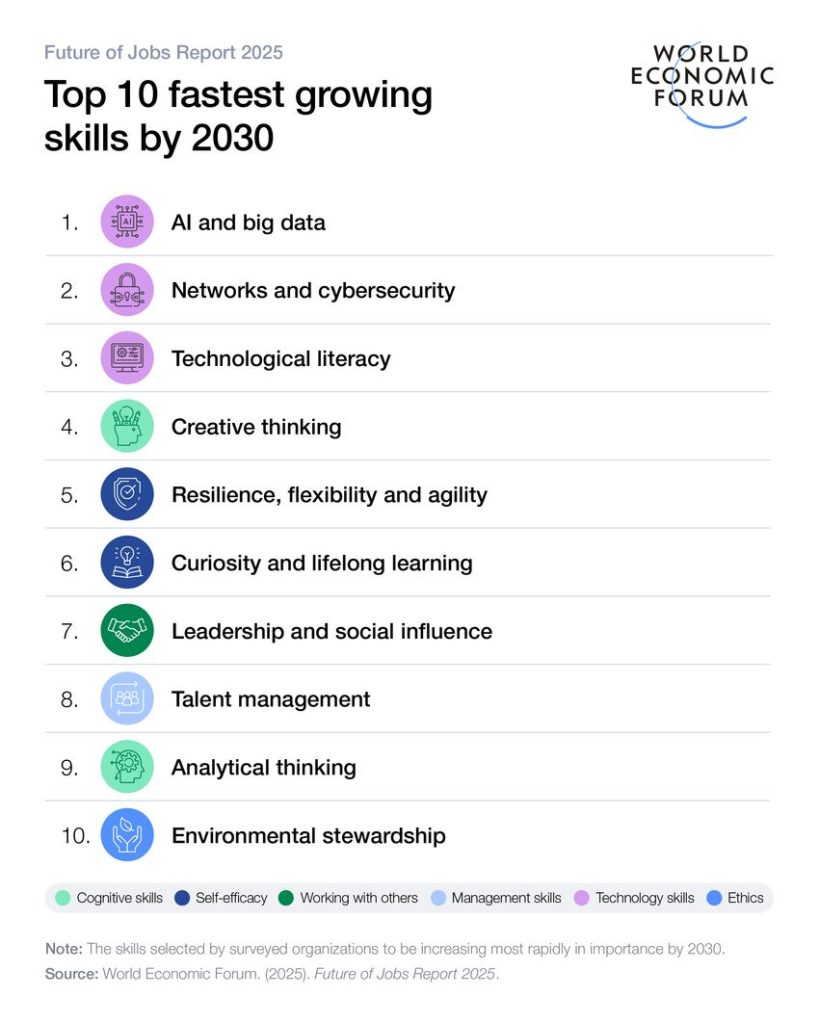
The World Economic Forum (WEF) offers some good clues in their Future of Jobs Report. If you are wondering where to invest your energy—and your team’s energy—these skills are a great compass.
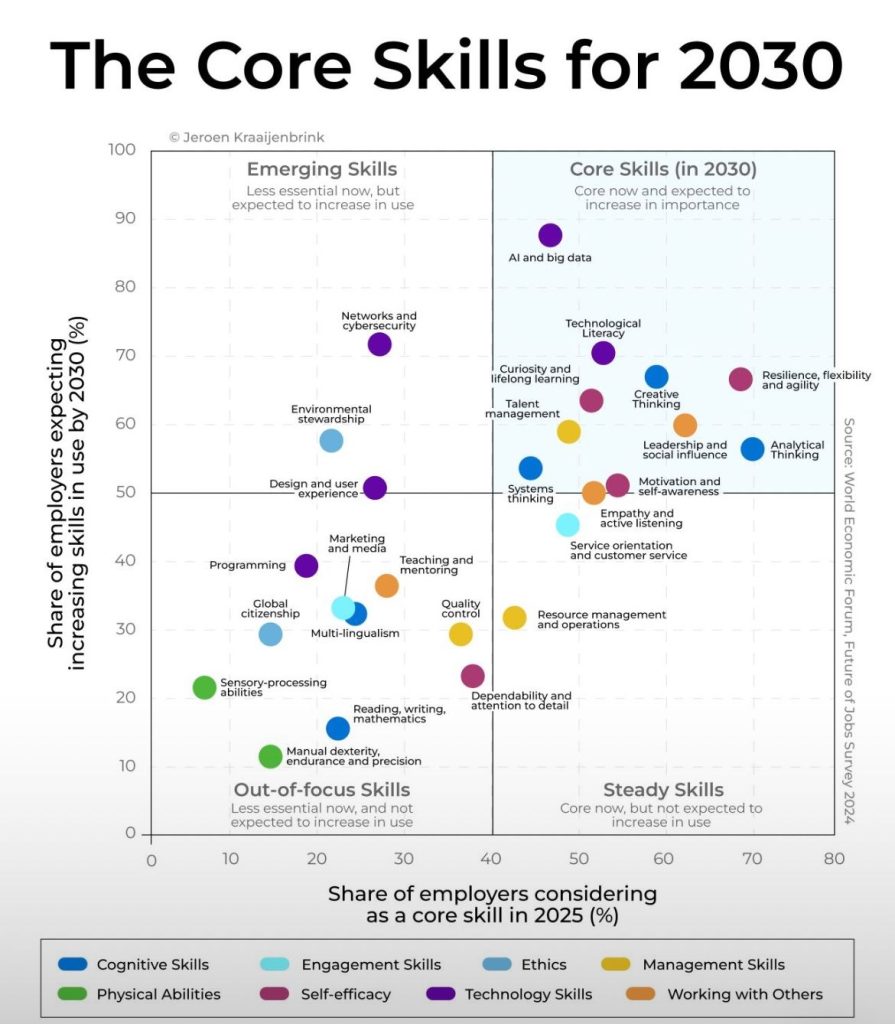
Here are the five pillars of professional growth for the coming decade:
1. Technology
AI and Big Data top the list. You can be an early adopter or a late one, but Artificial Intelligence is here to stay.
How to develop it:
- Start now: Whether you start small or big, just start.
- Educate yourself: Take an introductory course on AI tools relevant to your industry.
- Listen: Follow early adopters in your field to see how they are leveraging new tech.
2. Thinking
Creative thinking (innovation), systems thinking (seeing the full picture), and analytical thinking (converting data into information) are critical. As automation handles routine tasks, “thinking” becomes our primary value.
How to develop it:
- Brainstorm: Practice brainstorming beyond your comfort zone.
- Dig deeper: Get better at asking “Why?” several consecutive times.
- Scenario planning: Frequently ask “What if?” to explore alternative outcomes.
3. Human Connection
Leadership, social influence, talent management, and empathy. Human connection is, and will remain, on us. No technology can fully replace it. Great teams will always need leaders and empathic team members.
How to develop it:
- Be intentional: Do not just go through the motions in your interactions; be present.
- Coach, don’t command: Step up as a mentor rather than just a director.
- Learn motivations: Take time to understand what drives each person on your team.
4. Change & Resilience
Resilience, flexibility, and agility are non-negotiable. Between geopolitical shifts and rapid digitalization, we are not just witnessing change—we are living in constant transformation.
How to develop it:
- Expose yourself: Don’t hide from change; lean into it.
- Reframe: View challenges as learning opportunities rather than threats.
- Build grounding habits: Establish routines that keep you steady during uncertainty.
- Ditch perfection: Escape the need for perfection to remain agile and fast.
5. Learning
Curiosity and continuous learning are not just “nice-to-haves.” They are the survival skills that will keep you afloat in a rapidly checking market.
How to develop it:
- Read widely: Step outside your usual industry news.
- Ask questions: Never assume you know the answer.
- Block time: Schedule intentional training and upskilling sessions on your calendar.
The Takeaway
Invest in these skills. Invest in yourself, in your people, and in your kids’ future.
What do you think is missing from this list?
Leave a Reply