
Lucky Luke is one of the classics of European comics, and one of those memories that bring me back to my childhood. It was created by a Belgian artist called Morris in the late 40’s and René Goscinny (co-creator of Asterix, another great companion in my early times) also participated in the scripts in the 50’s. The setting is a caricature of the American Far West imaginary: saloons, gold rushes, the Dalton brothers, and a lonesome cowboy who shoots faster than his shadow.
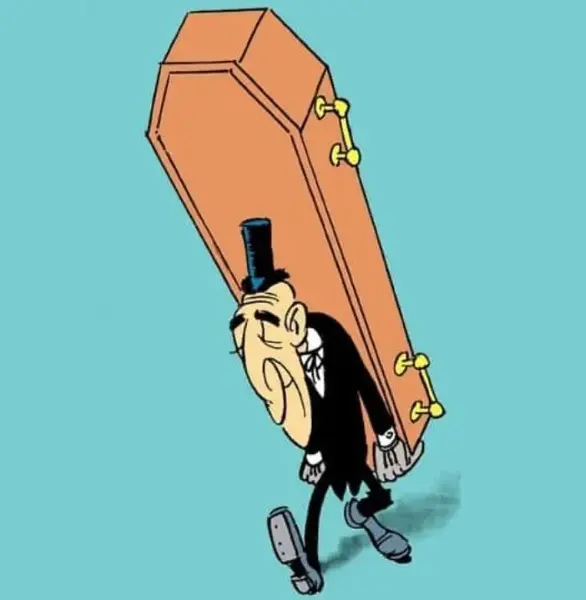
The undertaker who always arrives on time
One of the recurring secondary characters in the series is the undertaker (the “Croque-Mort”, in French). His defining trait is that he anticipates deaths. He appears discreetly before a gunfight or a duel. Then he takes the measurements of whoever is about to die, or sometimes he even already carries the coffins, taking the outcome for granted. It was one of my favorite moments in the series, early exposure to dark humor.
He always arrives just in time, with an expressionless face, as if he knew in advance who would need his services.
Even if you are not in the Far West, and you are not an undertaker, there are many similarities with your day-to-day in the industrial world.
When the customer will not wait
The undertaker has a very similar problem to many manufacturers: his customer lead time is shorter than his production lead time. The funeral will not wait for the coffin. If he wants to be on time, he must start production before the order arrives to his shop.
He has two options:
- Take measurements and launch production as early as possible. Whether he holds semi-finished coffins (Assemble to Order, ATO) or builds each one to measure (Make to Order or Engineer to Order, MTO/ETO), the logic is the same: if he wants to make it to the burial, he must start as soon as possible.
- Keep finished coffins in stock for a demand that is recurring and, at times, unexpected. This is Make to Stock (MTS). It carries some risk, but sometimes failing to deliver costs far more than a little inventory.
The same applies to our suppliers
With our suppliers, it works in a similar way. Sometimes we must share information with them before it is final, so they can anticipate part of the work:
- Securing materials.
- Reserving capacity.
- Preparing tooling or processes.
That is also early supplier involvement. It is not only about co-design; it is about giving the supplier enough visibility to start measuring the coffin before the duel.
Real life is harder
To be honest, the undertaker’s case is simpler than real life. He operates in a captive market. He is the only undertaker in town. Michael Porter would add that this kind of strategy and this knowledge of his “market” are also effective entry barriers for potential competitors.
His face also shows no emotion. No drama, no urgency. Anticipation turns a crisis (and there is little more critical than a violent death) into routine.
That is the real lesson. The goal is not to react faster to emergencies. It is to anticipate them so well that they stop being emergencies.