
Yesterday, I had the chance to attend a very interesting, dynamic, and fun conference on “Influence in Communication.”
It was given by Andrea Vilallonga and organized by the COIT AEIT (Official College and Spanish Association of Telecommunications Engineers).
One of the main ideas shared was simple yet powerful: we communicate even when we don’t speak.
While some aspects of our presence are beyond our control (our economic status, our body type, or face shape), there are many others we can actively work on. Our posture, our tone of voice, and especially our smile serve as universal signals of openness and connection.
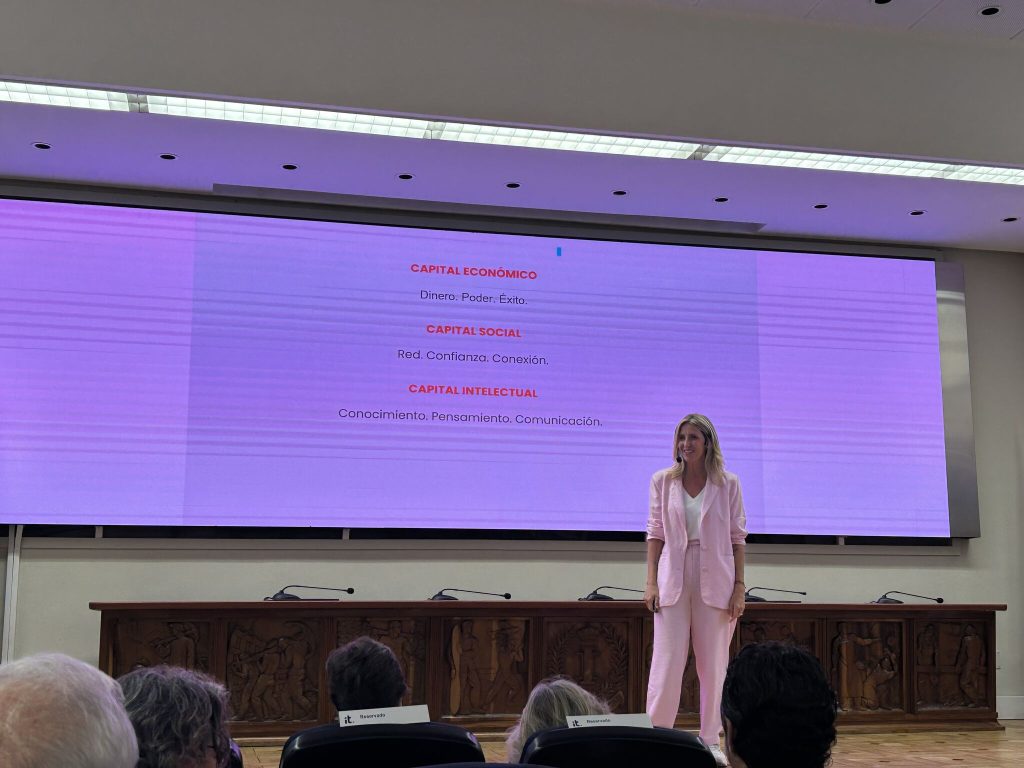
The 4 Types of Capital
Andrea shared the research of French sociologist Pierre Bourdieu, who described four types of “capital” that shape how we influence others.
Understanding these categories helps us analyze our own presence:
- Economic Capital: Money, power, and success.
- Social Capital: Network, trust, and connection. Think about “heliotropic” people—those who make you feel good when they enter a room because they listen, ask, connect, and simply smile.
- Intellectual Capital: Knowledge, thinking, and communication. It is not about what you want to say, but what the other person needs to hear.
- Erotic Capital: Presence, attraction, and impact. (Note: In this context, this refers to charisma and the ability to captivate an audience).
The Reptilian Brain & Instinct
We also discussed how much of influence is instinctive and processed by what Paul MacLean called the “reptilian brain.”
When we analyze the components of a message, the breakdown is often surprising:
- 55% comes from our body (Visual).
- 38% comes from how we move and our tone (Vocal).
- 7% comes from the actual words (Verbal).
The 30-Second Rule
Perhaps the most striking fact of the session was regarding first impressions.
The first impact we create lasts only 30 seconds… but the impression it leaves can remain for up to 6 months.
This serves as a great reminder that communication is not only about words. It is about presence, attitude, and awareness.
Leave a Reply