
“Perfect is the enemy of good.” I do not recall when I heard this sentence for the first time, but it has become one of my mantras for years. In every professional field and almost any task, there is always room to invest a few more hours. However, the return on that investment often diminishes quickly.
- Analytical Tasks: You can analyze more data or look at findings from different angles. You can even use more complex visuals to explain your results.
- Presentations: You can refine a speech an endless number of times. You could even ask for feedback from everyone in your contact list before the event.
- Decision Making: You can ask “why” as many times as you are able to speak or type.
Understanding when those extra steps are needed, and when they are not, is a key skill you acquire as you mature professionally. It involves consciously choosing between a deep dive or moving to a different task. Identifying what is “good enough” for each activity is not always easy, but it is essential to remain productive.
Lessons from the Past: The Illusion of Accuracy
I recalled this dilemma when I read an article by Miguel García Álvarez regarding time standardization. One of the documents featured in that post dates back to the year 1857. It shows the specific time in various cities compared to noon in Washington DC.
At that time, this level of detail was necessary because there was no standardized system of time zones as we have today. We cannot argue that the times shown in that historical table are more exact and more precise than the systems we use today. Back then, cities just a few miles apart maintained different “local times.”
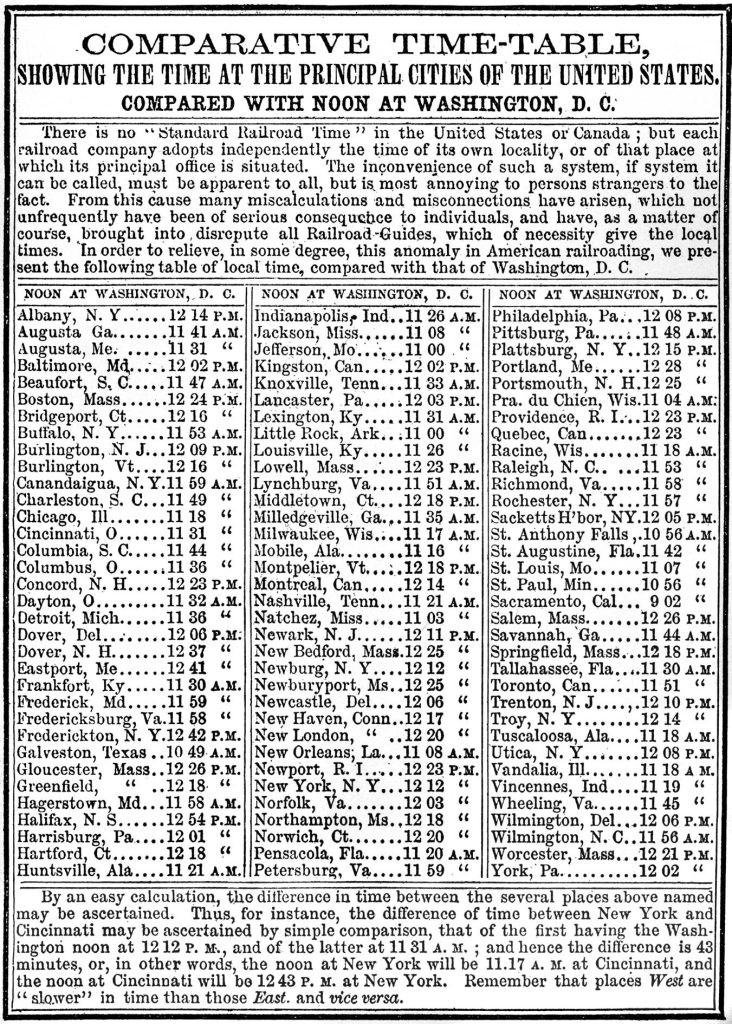
However, that extreme accuracy in 1857 did not help people at all. It was more accurate, more complete, and more “perfect,” but it was actually worse than what we have today. Imagine the number of adjustments you would need to make every time you traveled away from your home city. This is a perfect example of how seeking extreme precision can create more problems than it solves.
Accuracy Versus Agility
We should ask ourselves how this applies to our daily jobs. In the modern world, being “good and fast” is often much more valuable than being “perfect and late.” Many times, we wrongly believe that excellence is defined by doing more. This belief limits and delays our ability to have an impact.
- Data Volume: The fact that we can perform a very detailed analysis does not mean that we have to do so. Sometimes a rough analysis with big numbers tells the same story as an analysis with thousands of data points.
- Version Control: When you reach version 10 of a presentation, you are likely ready to practice and deliver. There is typically no need to fine-tune until version 25.
- Decisive Action: When a decision must be made, time is a critical variable. Asking for 100 pieces of evidence while you postpone a choice might be worse than making a slightly imperfect decision quickly.
We must avoid the trap of searching for perfection at the cost of progress. True excellence is knowing where to draw the line so you can move on to the next challenge.
Do you set yourself strict time boundaries to prevent spending too much time on a single task? Do you use a specific framework to define what “good enough” looks like for your team?
Leave a Reply